So I saw Masters of the Universe in the theater this week. Those of you who have heard me go on an on about what the Filmation cartoon means to me (like the time I met Skeletor and cried) might be curious about how I found the movie, and I’m glad to share my reactions with the understanding that they’re just that. I have big feelings about this silly toy line and cartoon, and I don’t aim to put them in anyone’s pocket. But if you really want to know…

SPOILERS below!
Headline: I had more fun watching it than I thought I would. The machinery of Hollywood is not built to create art for sensitive little dorks like me. What I love about He-Man is informed by my own challenging childhood and the time I encountered the property. My pal Ben Hatke sums up my feelings about the character very well in this short video essay, actually.

The film makers had no obligation to serve my specific tastes in making this movie–I’d argue it’d be a bad business move. So I went in with low expectations. As long as He-Man wasn’t shown as a dour, resentful hero who has to kill a guy in order to achieve some imagined narrative payoff, I’d probably like it fine. And I liked a lot of things in the movie. Duncan was great, Roboto was great, Adam/He-Man was great. And, as much as I don’t like seeing Jared Leto in movies, Skeletor was a lot of fun. Seeing the various henchmen portrayed so close to the original ideas was lovely to see on a big screen. They didn’t put Orko in it as comedy relief, played by Jack Black or Chris Pratt. What a relief!
But then we get the complicated feelings: The whole piece felt like it’s trying to be two opposing things at once. It’s playfully “faithful” to the images of the toys/cartoon of the 80s, but the playfulness is constantly undermined by a laughing disavowal of the ideas they’re paying tribute to. It’s a celebration that simultaneously elbows us as if to say, don’t worry, dudebros, his gentleness is only talk! Kindness is for wimps and phonies, right?
Context: I spent a handful of years making a podcast with my buddy Hoover about the 1980s Transformers cartoon, in which I repeatedly made the claim that this series of 30-minute toy commercials were made by people who, for the most part, respected kids and sincerely wanted to entertain them. When you watch interviews with the folks who worked on the original cartoon at Filmation it’s clear that they really respected their audience. It wasn’t just a response to angry parents and political groups that He-Man looked for nonviolent solutions to problems–they believed it was their responsibility as creators of children’s entertainment that they present positive ideas. Those ideas were very influential in my own journey.
So it was both tantalizing and disappointing to see how they played it both ways with Adam/He-Man’s approach to solving the conflict in the movie. Adam is sent to Earth as a child and grows up to work in a human resources organization with an emphasis on conflict resolution. Neat idea, I thought–this gives us a clear path to how he brings a more caring approach to the inevitable conflict with Skeletor. But we never see Adam show how good he is at that job. In fact, his boss is shown to be a bit of a phony who uses HR speak to conceal her hostility towards him. When he gets to Eternia and faces his first villain it feels like a gag when he rolls out some deescalation techniques. He gets thoroughly beaten until he finally activates the Power Sword and beats everyone up.
But later he talks to Duncan about his desire to find a way to solve problems by talking to people. He says he doesn’t like to fight.
Then he rushes off to save his parents from Skeletor. He beats the living heck out of a lot of bad guys. Stabs them in the stomach. Throws them into lava. And in his anger, someone he cares about gets killed.
Okay, I thought. He’s discovering there’s a Problem with Power.
Now he’ll come into the third act with a more synthesized approach that recognizes how the strongest person in the room has a moral responsibility to be the gentlest.
They kind of do that…? After another big fight with Skeletor, He-Man puts his sword down and trots out another deescalation technique that sounds like any you might have heard at a mandatory employee training day. And Skeletor naturally responds with sarcasm and violence. We get about 7 seconds of genuine trying to talk it out before He-Man “reasons” there’s nothing left but to beat Skeletor up. What follows is, I imagine for a lot of people, a cathartic scene. At least He-Man didn’t smile as he smashed up Skeletor’s face.
After a thorough thrashing, Skeletor relents. He’ll talk now. But He-Man says…ugh…
…he says, the time for talk is over. And he crushes Skeletor’s Havoc Staff.
Okay, I think. They’re doing an Avatar: The Last Airbender thing. He’s taking Skeletor’s power away from him so he can’t hurt anyone anymore. Skeletor will be taken to the prison mines and whatnot. This still works. But no, Skeletor dies when you destroy his staff.
Hooray…?
If you’re not sure why this bothered me, go watch Ben Hatke’s essay on He-Man or just watch this episode from the original series.
The movie wants to have it both ways. He-Man says he doesn’t like fighting, but he solves all his problems with fighting. In exposition they acknowledge that some fans love He-Man for presenting a surprisingly healthy image of masculinity, but in narrative they play the traditional action-hero-hits-the-guy-until-he’s-dead idea. The most powerful man in the universe couldn’t find a better way to solve conflict than to eradicate his enemy.
Don’t you dare come at me with the notion of it being more realistic or necessary to kill Skeletor–we’re talking about a story about a guy in furry underpants named He-Man.
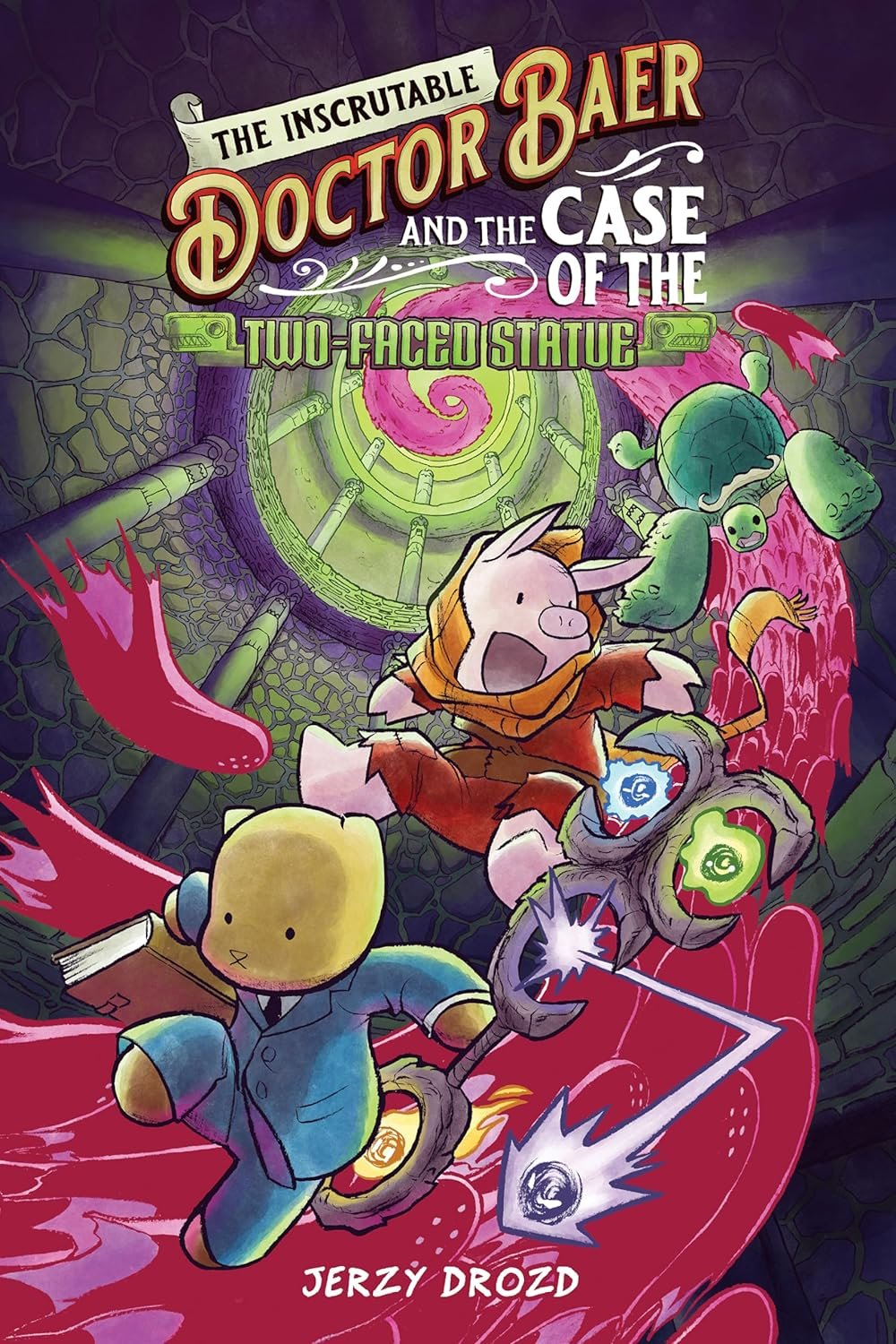
Look, it’s a miracle that this movie is as good as it is. It’s pretty entertaining. It genuinely celebrates a very silly toy and cartoon. I did have fun watching it. I just wish we were culturally further along in how we explore masculinity and conflict in adventure fiction. (Insert plug for The Inscrutable Doctor Baer and the Case of the Two-Faced Statue, which is my response to that problem.)
I’m not telling anyone to like it or not like it. He-Man isn’t mine. But I can have my own relationship with the property, and I always have the old shows to go back to. It can be whatever it wants to be for whoever wants to meet it where they are.
Oh, and it needed 2000% more Battlecat!